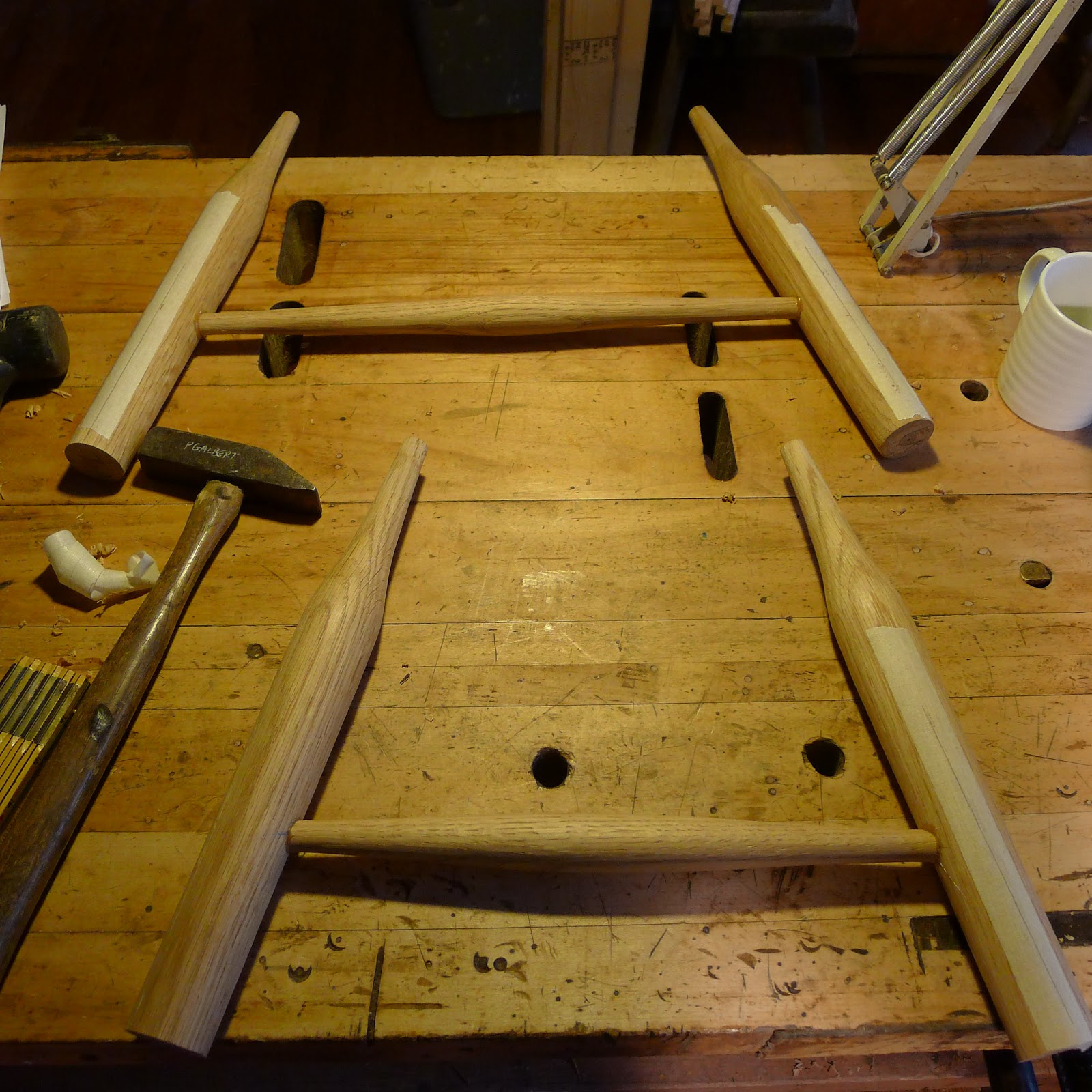
This evening I had the reason why I teach others to make chairs re-iterated to me.
Mike finished his Perch today. Great guy and a fine result. Mike took to every technique like a duck to water.
Friday morning Woody came and finished off his Continuous Arm Chair that he started a few weeks back. He couldn't attend the seventh and final day of the course as he went off to see some bloke called "The Boss" or Bruce Something, who was apparently singing a few tunes in a paddock near Hanging Rock. Woody's chair too, is a credit to him.
Both guys really enjoyed their respective chair making experiences. Both guys I believe will go on to continue making chairs in the future. That has to be the greatest compliment any person who I've taught in my workshop can give me. That they are inspired to continue their own chair making odyssey. It's how 'we' ensure that traditional woodworking is kept alive and thriving long after 'we' have departed.
Cheers Guys.
Sunday, 28 April 2013
Thursday, 25 April 2013
Tuesday, 23 April 2013
Off the grid.......for a while.
Life is great in Kyneton, but everyone needs a break. Lisa, Tom and I had not been away together for over 18 months. So Friday we packed the car and got out of town. Joining us were friends Sam and Michaela and their two kids Poppy and Gus.
McMillans Lookout, overlooking the town of Benambra, with The Brothers mountains in the
background.
We headed down the Princes Hwy to Bruthen turned up the Omeo Hwy to Omeo then headed to my parents high country farm at Uplands, about 12k's North of Benambra. The farm is about 150 acres on the Morass Creek and was the original location of the Uplands Post Office, which stood on the property until the 2003 bushfires, which razed it to the ground.
Uplands Post Office site, just to the left of the Pines in the distance, post 2003 fires.
Before that, the farm which had once been one of the best kept parcels of land in the district had been let go for decades and was in a horrible state, covered in blackberries, thistles and all manner of other noxious weeds. There were parts of the creek bank where you couldn't get to within 10 metres of the water. Now thanks to years of Dad's hard work it has been returned to it's former glory and is in fine shape.
Just as pleasant as the views across the paddocks of lucern and along the creek line are, there is another special quality that the property holds. Lack of phone coverage! Yep, mobiles are pretty much reduced to paper weights and that's a great thing for a day or two. So with the phone off and internet out of action, we settled into more important tasks, like lighting the fire and cleaning the camp oven.
Kennedy's Hut on the Mitta Mitta
Saturday. After a relaxing light bush walk along the Mitta Mitta River to Kennedy's Hut we slow roasted a piece of pork belly with homegrown tomato and eggplant salad for dinner.
Camp oven on the coals.
A few well deserved ales later...........
The view from Hotham Heights
On Sunday we took the kids to Mount Hotham for lunch and for a play in what was left of an early sprinkling of snow.
With the requisite snowman constructed then 'decommissioned,' snowballs hurled in all directions and boots wet through, we headed back to the farm, collected firewood for the fire that night and settled in for more good food and company. The kids ate their body weight in roasted marshmallows. Later that night everyone piled into the ute for a quick whip around the fence line on the lookout for wildlife. A dozen good sized eastern grey kangaroos, four wild deer and a hare hopping through the lucern paddock made their collective eyes pop and drew the odd excited squeal.
Monday morning we headed further North along the Corryong Rd to a spot on the Gibbo River where we knew of half a dozen magnificent Chestnut trees.
These trees would have been planted around gold rush times and just as in years past, they did not disappoint with literally thousands of Chestnuts covering the ground under their huge canopies.
Anyone who has ever tackled a Chestnut pod will know that it is one well protected little fortress. Those spikes are better than needle sharp and I'm still feeling the remnants of them in my fingers as I type.
But the nuts inside are well worth the fight and after an hour or so we had collected our fill just before the rain sent us back to our cars. The amazing thing was we didn't even get close to collecting the nuts from even one tree!
A late drive home last night and back into the workshop today putting the finishing touches to one of a number of rocking chairs I have on order. It's great to be home and refreshed for another couple of weeks of chair making, courses and.......... roasted Chestnuts.
Tuesday, 16 April 2013
A great pair.
Last week I had the pleasure of having Geoff and Peter in the workshop making a continuous arm chair each.
I enjoy the watching the week unfold. There's a familiar theme. A few days in the 'saddle' of the shave horse first. While not back breaking work, the first two days are long, especially when using tools which are unfamiliar to most, such as a drawknife. You can sense that in the back of their minds they are wondering if there's going to be enough time to get this chair made. I often get asked, "are we making good progress" or are we up to speed.
But in the days that follow, leg holes are drilled and reamed, the seat carved, legs and stretchers fitted and the crest rail that they carved by hand and steam bent on the second day, comes out of it's form and finds its way on to the arm posts.
Suddenly the chair begins to take shape. The seat with four legs now starts to resemble the chair that captured their attention when they first saw it.
Lastly, with spindles shaved to fine tolerances and 15 hand split wedges at the ready, glue is warmed and the crest rail is glued and wedged into place. A wave of relief washes over them, a smile appears and finally they get to see the fruits of a roller coaster week of new and interesting techniques that has culminated in a fine Windsor chair.
Peter and Geoff both made a great chair and it was a pleasure to have them in the workshop for the week. Even better to see the satisfaction on their faces as they loaded their chairs and patterns into their cars for the trip home. Well done guys.
I enjoy the watching the week unfold. There's a familiar theme. A few days in the 'saddle' of the shave horse first. While not back breaking work, the first two days are long, especially when using tools which are unfamiliar to most, such as a drawknife. You can sense that in the back of their minds they are wondering if there's going to be enough time to get this chair made. I often get asked, "are we making good progress" or are we up to speed.
But in the days that follow, leg holes are drilled and reamed, the seat carved, legs and stretchers fitted and the crest rail that they carved by hand and steam bent on the second day, comes out of it's form and finds its way on to the arm posts.
Suddenly the chair begins to take shape. The seat with four legs now starts to resemble the chair that captured their attention when they first saw it.
Lastly, with spindles shaved to fine tolerances and 15 hand split wedges at the ready, glue is warmed and the crest rail is glued and wedged into place. A wave of relief washes over them, a smile appears and finally they get to see the fruits of a roller coaster week of new and interesting techniques that has culminated in a fine Windsor chair.
Peter and Geoff both made a great chair and it was a pleasure to have them in the workshop for the week. Even better to see the satisfaction on their faces as they loaded their chairs and patterns into their cars for the trip home. Well done guys.
Wednesday, 3 April 2013
An eventful week
The past three days I've spent up the road at Keith's farm milling an ever increasing pile of logs. It's one of those 'things' that have been on my list of 'things to do' for some time, but ironically, time is the issue.
So when I noticed a small opening in between a couple of Continuous Arm Chair courses I raced down to Dad's farm, collected the sawmill and readied myself to mill as much as I could in four days.
The first couple of days started with a bang. I had the mill set up by late morning and managed to have half a dozen good sized English Oak logs milled by the days end.
The second day started with another English Oak, followed by two of the best Poplar logs I've come across.
Almost dead centre heart and as straight as a gun barrel. I know there are purest furniture makers out there who dismiss poplar as a secondary wood in comparison to even pine, but having used it for over seven years now I can absolutely vouch for its stability, ease of hand planing, sawing, dovetailing and all round usability.
Thirty minutes later the above log had been squared and reduced to a dozen perfect boards.
Straight grained , nice figure and absolutely clear Poplar.
Not every log in the pile was as straight forward as the Poplar. Just last week I was fortunate enough to score an Algerian Oak from Riddells Creek. Not the best saw log by a long stretch, but then how often do you come across such a mature specimen of Algerian Oak? Ummm, not often.
It took a while to get the whole thing squared up and the big branch inclusions made the blades distort a little, but I think the end result was worth it. Some of the best ray fleck I've seen in Oak of any species.
I ended up with three of these 60mm thick boards with matching ray fleck. Pretty nice.
Even when rift sawn the figure in this Algerian Oak is stunning.
But as I've discovered countless times before milling logs, you have to take the good with the bad. The bad came in the form of this Pin Oak which had been growing along side an historic old home in Woodend.
Before I even got it on the mill I dug out this square section tube, chain and roofing nails which had been there for so long that the tree had grown about 60mm over the lot. I should have left it at that, but the thought of some straight Pin Oak boards made me persist.
When you hit a nail with a bandsaw, there is a distinctive 'zip' noise, followed often by the cut quality dropping.
This picture repeated itself about a dozen times. There were more zips than a zipper factory! I lost count of the nails I dug out of the log until in the end I gave up on it. One things for sure, the Pin Oak wasn't suffering from an iron deficiency!
But on the good side again, I finished up with some Elm from the trees that fell down near the Campaspe River. I had to rip the log down the middle just to get it on the mill! Here's a couple of the boards from just one half of the log. Over half a metre wide, 60mm thick and all together stunning!
I've got a full day today in the workshop, preparing for our next chair course which starts on Sunday and a visit from the Furniture History Society members on Saturday. But tomorrow morning two mates, Tim and Bern will be on the doorstep bright and early for another full days milling. We are going to tackle some of the biggest logs I've ever come across. From English Oak to more massive Elms. There's a bit of Chestnut there too and even Holly. I've got a feeling it's going to be a good day!
So when I noticed a small opening in between a couple of Continuous Arm Chair courses I raced down to Dad's farm, collected the sawmill and readied myself to mill as much as I could in four days.
The first couple of days started with a bang. I had the mill set up by late morning and managed to have half a dozen good sized English Oak logs milled by the days end.
The second day started with another English Oak, followed by two of the best Poplar logs I've come across.
Almost dead centre heart and as straight as a gun barrel. I know there are purest furniture makers out there who dismiss poplar as a secondary wood in comparison to even pine, but having used it for over seven years now I can absolutely vouch for its stability, ease of hand planing, sawing, dovetailing and all round usability.
Thirty minutes later the above log had been squared and reduced to a dozen perfect boards.
Straight grained , nice figure and absolutely clear Poplar.
Not every log in the pile was as straight forward as the Poplar. Just last week I was fortunate enough to score an Algerian Oak from Riddells Creek. Not the best saw log by a long stretch, but then how often do you come across such a mature specimen of Algerian Oak? Ummm, not often.
It took a while to get the whole thing squared up and the big branch inclusions made the blades distort a little, but I think the end result was worth it. Some of the best ray fleck I've seen in Oak of any species.
I ended up with three of these 60mm thick boards with matching ray fleck. Pretty nice.
Even when rift sawn the figure in this Algerian Oak is stunning.
But as I've discovered countless times before milling logs, you have to take the good with the bad. The bad came in the form of this Pin Oak which had been growing along side an historic old home in Woodend.
Before I even got it on the mill I dug out this square section tube, chain and roofing nails which had been there for so long that the tree had grown about 60mm over the lot. I should have left it at that, but the thought of some straight Pin Oak boards made me persist.
When you hit a nail with a bandsaw, there is a distinctive 'zip' noise, followed often by the cut quality dropping.
This picture repeated itself about a dozen times. There were more zips than a zipper factory! I lost count of the nails I dug out of the log until in the end I gave up on it. One things for sure, the Pin Oak wasn't suffering from an iron deficiency!
But on the good side again, I finished up with some Elm from the trees that fell down near the Campaspe River. I had to rip the log down the middle just to get it on the mill! Here's a couple of the boards from just one half of the log. Over half a metre wide, 60mm thick and all together stunning!
I've got a full day today in the workshop, preparing for our next chair course which starts on Sunday and a visit from the Furniture History Society members on Saturday. But tomorrow morning two mates, Tim and Bern will be on the doorstep bright and early for another full days milling. We are going to tackle some of the biggest logs I've ever come across. From English Oak to more massive Elms. There's a bit of Chestnut there too and even Holly. I've got a feeling it's going to be a good day!
Tuesday, 2 April 2013
Rubber bands and carrots
Last week I had the pleasure of having a local in the workshop making a continuous arm chair with me. It was a great week and Woody was a natural with most of the chair specific hand tools. I guess that's what you would expect from someone who is carving an arched back guitar in his spare time. He even took to the carving of the complex curve on the underside of the chair with the drawknife with ease. Nice work mate.
Although my chair classes are anything but rigid in their structure, I do like to ensure that we get the crest rail carved and steam bent by the end of the second day. This gives ample time for it to set in the drying box prior to being drilled and fitted to the chair at the end of the week. I carved one at the same time as I have an order for a continuous arm rocker.
So while our crest rails were steaming away in the kiln we readied our bending forms over a cup of coffee. At the time I thought it would be pertinent to let Woody know that sometimes the crest rails delaminate or worse still, fail completely. Such is the joy of working with the natural product that is timber...... and steaming it like a dim sim!
To ease Woody's mind, I retrieved my crest rail first, wedged it into the form and .........snap. Just like a carrot. I kept bending, to check if it was just a fault in that part of the crest. Snap, snap, snap. Nope, it was the whole thing. Having bent literally dozens and dozens of these things it was just a case of c'est la vie. Woody on the other hand was not looking entirely pleased or confident
A few minutes later we bent Woody's crest. It bent like a rubber band. Not even the slightest delamination and with the exception of a slight compression on the right side, a near perfect bend. Interesting part? Both blanks were from the same board, a 60mm thick, quarter sawn, green, Blackwood blank. Both had absolutely no visible inclusions or defects. Just to check, I shaped and bent another 3. Same deal, two snapped like carrots and the third compressed so badly it was unusable.
So I'm putting this episode down to an exacting diagnosis of 'buggered if I know?' This Blackwood is good stuff. As you can see above, it splits very well. It's certainly strong enough before steaming. But whatever the reason, it's all good. It's a constant learning curve and I've yet to meet or even hear of anyone who has absolutely mastered the art of steam bending.
However, for the last few days I've been back on the sawmill and milling all sorts of Oak and if anything bends well it's Oak. More on that soon.
Sunday, 31 March 2013
The old grey mare, she ain't what she used to be
The first Windsor Chair I made with Curtis Buchanan, I used hide glue. I have to admit it was my first introduction to the stuff and by the time I had finished gluing up the legs and stretchers I was well and truly intimidated. You see Curtis mixed his own brew from granulated glue pellets. He then spoke of differing gram strengths, retardation by way of salt, etc etc. At that point all I knew of the stuff was that it was generally made of horse or cow bits and or, as Jack Plane just posted.... The Easter Bunny
At that point Charlie, who was making a chair at the same time, had the misfortune to glue the wrong end of his stretcher into a leg. He realised his mistake the split second he did it. Curtis immediately grabbed that leg and stretcher and wailed on the joint with a dead blow mallet like a man possessed, trying to get it apart. It was a fearsome assault on the leg! I stood there slack jawed and speechless.
The joint held true, didn't even look like budging and shortly after the leg had to cut off the stretcher on the bandsaw and the leg re-turned on the lathe. Wow. That horse sauce had some grip and the tack time was lightening quick. So much so that it put me off the stuff for ages.
Fast forward a few years and I found myself back in the U.S. and in Pete Galbert's workshop. Enter the hide glue! But before I could work myself into a frenzy about the stuff, Pete showed me the bottle from which it came. Old Brown Glue. Pete swore by it. I glued the stretchers into the legs without issue and with a much more relaxed tack time too.
I went on to use it on all three of the classes that Pete taught when he was out here in Australia. We glued up over 30 chairs and stools in that time, with out so much as one glue related issue. I have since used it exclusively on every chair I've made, all my chair classes and I recommend it to anyone who asks. It really is that good.
Why am I so shamelessly promoting Old Brown Glue I hear you ask? Well that's what you do when you sell the stuff and I'm very proud to say that's just what Lisa and I are now doing as the Australian distributors.
Available in both 5oz and 20oz bottles we have our first shipment on the shelf in the shop already and available for all the budding chair makers out there. How much? I hear you say.... $10 for the 5oz and $22 for the 20oz. So cheaper than you can purchase it from the U.S. and get it posted out here. No we are not hell bent on making our fortune from glue! And that's exactly how we want it to be. Readily available and not a price where you have to auction off a body part to afford it.
And it's not just for the chair makers either. Developed by Patrick Edwards, one of America's best marquetry experts it is the ants pants for veneering ( and all manner of other furniture making applications! ) and it's about the only glue around that is reversible too. I could waffle on for ever about how good it is, but instead, see for yourself by heading to their website - Old Brown Glue
So if your in the area, stop in and get yourself and bottle.
Oh, the old grey mare, she ain't what she used to be, ain't what she used to be...........
Sunday, 24 March 2013
From bands into boxes.
This afternoon saw six prospective new box makers fit and finish the tops and bases of their 3 Shaker oval boxes on the second day of our box making course. As I mentioned in a recent post, oval boxes are a very simple form but they are certainly more than the sum or their four parts. Despite the odd delamination of a band here and a copper tack skewing off track there, everyone took home three fine looking boxes. A testament to their hard work over the weekend and attention to detail.
Good friend Tim came up also and got in on the spirit of things, making 3 great boxes too.
Tim's three boxes, with Spalted Ash, Spalted Sassafras and Blackwood tops
Six happy box makers...with a smallish Rundell in the front.
All in all a successful weekends work with about 22 boxes made over the 2 half days. Enough to make me want to get straight back in to the workshop in the morning and make a batch for myself. But that will have to wait as starting tomorrow I'll be teaching a local how to make a Continuous Arm Chair instead....but I'm sure I'll be enjoying that
just the same!
Tuesday, 19 March 2013
The George Thwaites Tool Chest - Part II
Some of you who have been following my blog may recall the post about the tool chest of George Thwaites, one of Melbourne's first and most regarded colonial furniture makers. If you haven't seen it, you can read about it here.
George's Chest made the journey to Kyneton with us a little over 18 months ago and has been stored safely since. Time and commitments have meant that I rarely get a chance to do anything but steal a glance at it on occasion. That was until today, when Rob and Libby La Nauze came to visit both me and the chest. I had met the La Nauze's about 8 months ago when they were among a group of George's relatives and other interested parties who came and had a brief look at the chest one morning. Libby is a direct descendant of George.
Recently Rob had been asked to write an article about George's chest and tools. Rob has already written a book on another of member of the Thwaites family, William. William was the Melbourne engineer who was responsible for the entire Melbourne Metropolitan Sewerage system and has been apparently referred to as Melbourne's answer to 'Gustave Eiffel!' Here is a link to Robs book, Engineer to Marvelous Melbourne - The life and times of William Thwaites.
What was exciting about todays meeting at the workshop was the cargo that Rob and Libby arrived with. About 30 or so of George's moulding planes and tools! Rob has fastidiously catalogued and studied all of the planes in his possession and had a wealth of newly acquired knowledge and information, not only about the planes makers, but whether it was likely they were part of the original compliment of tools bought out in 1842, or purchased after George's arrival.
There were some absolutely suburb examples amongst Rob and Libby's collection of planes, including some extremely rare and very sought after makers. I don't want to precede Rob's article with too much information but there was one particular plane that really captured my attention.
This John Moseley & Son plane also had the retailer James McEwan & Co. stamped into the toe. McEwans was one of Melbourne's first hardware stores, having its origins in the Ballarat Goldfields in the 1850's. ( it was to be bought out in the 1990's by the monopoly that is Bunnings..... ) Melbournians of my vintage or older would remember Mc Ewan hardware stores well.
Here's one of their early advertisements.
Could you imagine in those days, walking into your local corner hardware store and being able to put your hands on a brand new John Moseley & Son plane! Outstanding. That would be my kind of hardware store.
Suffice to say we had a great day and lunch on Piper Street, discussing George's chest and tools at length. It seems there is a lot more ground to cover and no doubt more information to come forth which is sure to be very interesting indeed. Thanks Rob and Libby for a very informative day. It's fantastic to talk with people as passionate about our history as I am. I look forward to uncovering more about George's tool chest in the near future.
George's Chest made the journey to Kyneton with us a little over 18 months ago and has been stored safely since. Time and commitments have meant that I rarely get a chance to do anything but steal a glance at it on occasion. That was until today, when Rob and Libby La Nauze came to visit both me and the chest. I had met the La Nauze's about 8 months ago when they were among a group of George's relatives and other interested parties who came and had a brief look at the chest one morning. Libby is a direct descendant of George.
Recently Rob had been asked to write an article about George's chest and tools. Rob has already written a book on another of member of the Thwaites family, William. William was the Melbourne engineer who was responsible for the entire Melbourne Metropolitan Sewerage system and has been apparently referred to as Melbourne's answer to 'Gustave Eiffel!' Here is a link to Robs book, Engineer to Marvelous Melbourne - The life and times of William Thwaites.
What was exciting about todays meeting at the workshop was the cargo that Rob and Libby arrived with. About 30 or so of George's moulding planes and tools! Rob has fastidiously catalogued and studied all of the planes in his possession and had a wealth of newly acquired knowledge and information, not only about the planes makers, but whether it was likely they were part of the original compliment of tools bought out in 1842, or purchased after George's arrival.
There were some absolutely suburb examples amongst Rob and Libby's collection of planes, including some extremely rare and very sought after makers. I don't want to precede Rob's article with too much information but there was one particular plane that really captured my attention.
This John Moseley & Son plane also had the retailer James McEwan & Co. stamped into the toe. McEwans was one of Melbourne's first hardware stores, having its origins in the Ballarat Goldfields in the 1850's. ( it was to be bought out in the 1990's by the monopoly that is Bunnings..... ) Melbournians of my vintage or older would remember Mc Ewan hardware stores well.
Here's one of their early advertisements.
Could you imagine in those days, walking into your local corner hardware store and being able to put your hands on a brand new John Moseley & Son plane! Outstanding. That would be my kind of hardware store.
Suffice to say we had a great day and lunch on Piper Street, discussing George's chest and tools at length. It seems there is a lot more ground to cover and no doubt more information to come forth which is sure to be very interesting indeed. Thanks Rob and Libby for a very informative day. It's fantastic to talk with people as passionate about our history as I am. I look forward to uncovering more about George's tool chest in the near future.
Saturday, 16 March 2013
It's hard saying no.
It's hard to believe we are nearly a quarter the way through the year already. It's been a busy year so far with running the shop, setting up and working in the new workshop and opening the cottage for business. Then there's the courses.
Some freshly milled Otways Blackwood and Hard Maple bands for the box class
Next weekend we run our first official Shaker Oval Box making class. I've been making them for years now and I still enjoy it as much as the first box I made with John Wilson in Michigan. It's not a difficult process, it's anything but difficult. It's just a case of presenting it in a logical & enjoyable format.
The issue we've been facing lately however is trying to accommodate those who want to take part in our courses. Although we suggest to book early we are still finding that on occasion we are having to turn down people or defer them to a future course. It's an unfortunate circumstance, so for some classes now we are creating standby lists in the event that we have a cancellation.
Small consolation, but Lisa and I both feel that it is as important to stick to our business plan which allows for 2-3 courses per month with limited numbers, as well as allowing time for making products for our shop.
It ensures also that we don't follow down the path of just increasing the course numbers until we reach critical mass, jamming in people like sardines and turning what should be a fantastic learning experience into an uncomfortable and hectic mess. I've experienced it first hand and it's something I wont have a part in again.
Fiddleback or curly figured Blackwood in our No.2 box bands.
So while it's hard to say no, think of it as us saying 'yes' - to retaining the quality and integrity that we think sets our business apart from some others.
Wednesday, 13 March 2013
1774
An important year for what was to become arguably one of the most successful and unique religious sects in America, if not the world. It marked the beginning for Shakers and now marks a new beginning for Lisa and I too as we have named our cottage 1774.
With all but the seed for the front lawn being sown, ( no, it's not Shaker seed.... ) 1774 is finished and ready for day trippers, couples or friends wanting a weekend away and enthusiastic chair making and wood working clients to enjoy. A page will be added to our website in the next day or so but in the meantime interested parties can contact us via the contact details on the website.
We offer reduced rates during the week and clients who are partaking in a chair making course can book the cottage for less than half price for the duration of the course. That's cheaper than the local budget motel. Only a leisurely 3 min walk to historic Piper Street, a 5 min walk to the workshop and 10 to the beautiful Kyneton Botanic Gardens and Campaspe River, it's in the ideal position for those wanting to take in all that Kyneton and the region has to offer.
And if your staying here on a Friday or Saturday afternoon/night come and have your first drink at the bar on us! Cheers, and hope to see you in town soon.
With all but the seed for the front lawn being sown, ( no, it's not Shaker seed.... ) 1774 is finished and ready for day trippers, couples or friends wanting a weekend away and enthusiastic chair making and wood working clients to enjoy. A page will be added to our website in the next day or so but in the meantime interested parties can contact us via the contact details on the website.
We offer reduced rates during the week and clients who are partaking in a chair making course can book the cottage for less than half price for the duration of the course. That's cheaper than the local budget motel. Only a leisurely 3 min walk to historic Piper Street, a 5 min walk to the workshop and 10 to the beautiful Kyneton Botanic Gardens and Campaspe River, it's in the ideal position for those wanting to take in all that Kyneton and the region has to offer.
And if your staying here on a Friday or Saturday afternoon/night come and have your first drink at the bar on us! Cheers, and hope to see you in town soon.
Tuesday, 12 March 2013
An odd angry shot.
The OK Corral, a Civil War battle or Billy the Kid up against Arizona Rangers? Or perhaps a more contemporary Bonnie and Clyde incident. What was all the conjecture about?
A few days earlier I had been preparing some U.S. Yellow Pine seat blanks for our next Perch class when I saw the familiar shine of metal reflecting back at me from the surface of the timber. My worst fears of a nail or other lump of steel were soon allayed when the metal turned out to be lead. Or more specifically a bullet.
Last month I had been asked by Michael if I could reserve him the next sequential seat blank from my Yellow Pine board, for his second Perch class. He was after a perfect grain match. And this bullet laden blank was that match.
Nice work fellas.
So on the last day of the Perch class just gone, the Michael, David and I pondered just how that lone bullet found it's way into the Pine tree and how long it may have sat there, undisturbed. Perhaps 10 years, perhaps 100. Either way I'm sure it will be an interesting topic for conversation for the next 100 years too.
A few days earlier I had been preparing some U.S. Yellow Pine seat blanks for our next Perch class when I saw the familiar shine of metal reflecting back at me from the surface of the timber. My worst fears of a nail or other lump of steel were soon allayed when the metal turned out to be lead. Or more specifically a bullet.
Last month I had been asked by Michael if I could reserve him the next sequential seat blank from my Yellow Pine board, for his second Perch class. He was after a perfect grain match. And this bullet laden blank was that match.
Nice work fellas.
So on the last day of the Perch class just gone, the Michael, David and I pondered just how that lone bullet found it's way into the Pine tree and how long it may have sat there, undisturbed. Perhaps 10 years, perhaps 100. Either way I'm sure it will be an interesting topic for conversation for the next 100 years too.
Subscribe to:
Posts (Atom)